|
||||||||||||||||||||||||||||||||||||
| [
Contents
] [ INDEX ]
|
||||||||||||||||||||||||||||||||||||
|
Original papers COMPARATIVE ANALYSIS OF ADOLESCENT PREGNANCIES COMPLETED BY DELIVERY AT THE ZAJEČAR MATERNITY HOSPITAL IN 2007 AND 2025 Vera Najdanović Mandić ORDINANCE "HARMONY, ZAEČAR, SERBIA |
||||||||||||||||||||||||||||||||||||
|
|
||||||||||||||||||||||||||||||||||||
| Download in pdf format | Summary: Introduction:
Adolescence (from the Latin adolescere, meaning “to become mature,
to grow up”) lasts from 10 to 19 years according to the definition
of the World Health Organization. Adolescent pregnancy represents a
significant medical and social challenge. The aim of this study was
to compare epidemiological parameters and perinatal outcomes at the
maternity ward in Zaječar over an 18-year period, specifically to
analyze and compare the frequency and outcomes of deliveries among
adolescent girls in Zaječar, and to present the incidence of
adolescent births, newborn birth weight, mode of delivery, and
employment status of adolescent mothers in 2007 compared to 2025 in
Zaječar. METHODS: A retrospective analysis of delivery records and
medical histories of women who gave birth at the Gynecology and
Obstetrics Department of the Health Center Zaječar, along with
statistical data analysis. RESULTS: The results show that the total
number of deliveries almost halved from 2007 to 2025, from 555 to
298. The number of adolescent mothers also decreased from 46 (8.29%)
in 2007 to 11 (3.69%) in 2025, which is statistically significant
(χ² = 4.72; p = 0.029). The majority of newborns of adolescent
mothers in 2007 were eutrophic, 39 (84.78%), with a mean birth
weight of 2850 g ± 410, while in 2025 all newborns were eutrophic
with a mean birth weight of 3100 g ± 350 g, but without a
statistically significant difference (t = 1.41; p = 0.16). In both
observed periods, deliveries were predominantly vaginal, although
the frequency of cesarean sections was higher in 2025, without
statistical significance (χ² = 1.56; p = 0.21). Adolescent mothers
were predominantly unemployed in both periods. CONCLUSION:
Comparative analysis shows that the proportion of adolescent
deliveries significantly decreased from 8.28% in 2007 to 3.69% in
2025 (χ² = 4.72; p = 0.029). No statistically significant difference
was found in birth weight (t = 1.41; p = 0.16). The frequency of
cesarean sections was higher in 2025, but without statistical
significance (χ² = 1.56; p = 0.21). In both 2007 and 2025,
adolescent mothers were unemployed and economically dependent. One
of the major tasks for obstetricians and gynecologists is to
identify adolescents at risk and prevent behaviors leading to
unintended pregnancy. Further work on primary prevention in local
communities of eastern Serbia is necessary. Keywords: adolescent pregnancy, childbirth, vaginal delivery, caesarean section, eutrophic newborn, birth weight, reproductive health. |
|||||||||||||||||||||||||||||||||||
|
INTRODUCTION Adolescence (from the Latin adolescere, meaning “to become mature, to grow up”), as we understand it today, is the result of physical, physiological, and psychological development, as well as the social and cultural conditions of the environment. According to the definition of the World Health Organization from 1980, it lasts from 10 to 19 years (1). Earlier physical maturation, accompanied by early sexual experience and non-use of contraceptive methods, leads to accidental, unplanned, and unwanted pregnancy (2). For safe motherhood, in addition to physical capability, which older adolescents possess, emotional stability, maturity, and experience are also necessary (3). Adolescent pregnancies are a global public health issue. Since 2019, adolescent girls aged 15–19 years in low- and middle-income countries have had an estimated 21 million pregnancies annually, resulting in 12 million births, while 55% of unintended pregnancies end in abortion, which is often unsafe. Adolescent mothers face a higher risk of eclampsia, puerperal endometritis, and systemic infections compared to women aged 20–24 years, while infants of adolescent mothers face a higher risk of low birth weight, preterm birth, and severe neonatal conditions. Data on births among girls aged 10–14 years are becoming increasingly available. Globally, the birth rate among girls aged 10–14 years in 2023 was estimated at 1.5 per 1,000 women, with higher rates in sub-Saharan Africa and Latin America and the Caribbean. Preventing pregnancy among adolescents, as well as pregnancy-related mortality and morbidity, is fundamental for achieving positive lifelong health outcomes and is imperative for meeting sustainable development goals related to maternal and newborn health (4–6). Aim of the study: To analyze and compare the frequency and outcomes of deliveries among adolescent girls in Zaječar across two time periods, specifically to present the incidence of adolescent births, newborn birth weight, mode of delivery, and employment status of adolescent mothers in 2007 versus 2025 in Zaječar. Participants and Methods RESULTS Table 1: Frequency and parity of women who gave birth in the GA department in ZC Zaječar in 2007
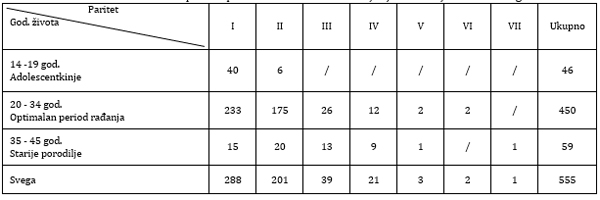
In 2007, a total of 555 deliveries were recorded at the Gynecology and Obstetrics Department of the Health Center Zaječar. The majority of women, 450 (81.08%), were aged between 20 and 34 years, i.e., in the optimal reproductive age. Primiparous women predominated with 288 (51.89%), followed by secundiparous women with 201 (36.22%). There were 59 (10.63%) older parturients, mostly secundiparous (20; 33.89%). The oldest primiparous woman was 42 years old, while the oldest women who gave birth were 45 years old (fourth- and seventh-time mothers). In the adolescent age group, there were 46 (8.29%) parturients. Table 2: Frequency and parity of women giving birth in the GA department in ZC Zaječar in 2025
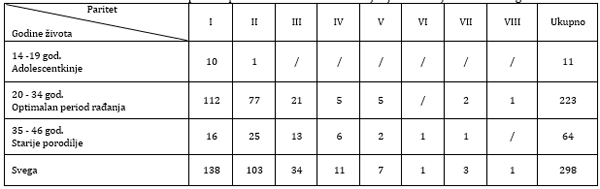
In 2025, a total of 298 deliveries were recorded at the Gynecology and Obstetrics Department of the Health Center Zaječar. The majority of women, 223 (74.83%), were aged between 20 and 34 years, i.e., in the optimal reproductive age. Primiparous women predominated with 138 (46.31%), followed by secundiparous women with 103 (34.56%). There were 64 (21.48%) older parturients, mostly secundiparous women (25; 39.06%). The oldest primiparous woman was 44 years old, while the oldest woman who gave birth was 46 years old (a third-time mother). In the adolescent age group, there were 11 (3.69%) parturients. Table 3: Age and parity of adolescent mothers in the GA department of ZC Zaječar in 2007
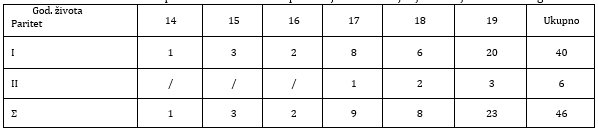
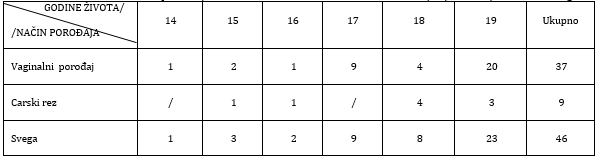
In 2007, there were 46 adolescent parturients (8.28%). The youngest was 14 years old. The majority were 19-year-olds, 23 (50%). Forty women were primiparous, while 6 were secundiparous. Table 4: Age and parity of adolescent mothers in the GA department of ZC Zaječar in 2025
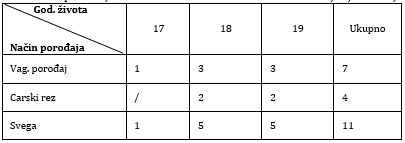
In 2025, there were 11 adolescent parturients (3.69%). The youngest was 17 years old. Ten were primiparous, while only one was secundiparous, aged 18. The total number of deliveries almost halved from 2007 to 2025, from 555 to 298, while the number of adolescent parturients also decreased from 46 (8.29%) in 2007 to 11 (3.69%) in 2025, which is statistically significant (χ² = 4.72; p = 0.029). Table 5: Presentation of the body weight of newborns of adolescent mothers born in the GA department of ZC Zaječar in 2007
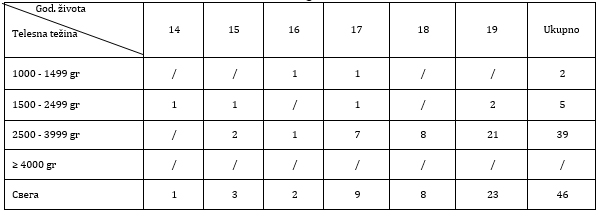
Newborns by birth weight are classified as follows: normal weight (2500–3999 g), low birth weight (1500–2499 g), very low birth weight (1000–1499 g), and macrosomic (>4000 g) (5). Birth weight is an indicator not only of the mother’s health and nutritional status, but also a prognostic factor for the newborn’s survival, growth, long-term health, and psychosocial development. In our 2007 sample, 39 (84.78%) newborns were eutrophic, with a birth weight ranging from 2500 to 3999 g. Low birth weight was recorded in 5 (10.87%) newborns, while 2 (4.35%) had very low birth weight. In 2025, all 11 newborns were eutrophic. The majority of newborns of adolescent mothers in 2007 were eutrophic (39; 84.78%), with a mean birth weight of 2850 g ± 410, while in 2025 all newborns were eutrophic, with a mean birth weight of 3100 g ± 350 g, with no statistically significant difference (t = 1.41; p = 0.16). Our sample is too small to confirm the widely accepted findings in the literature that newborns of adolescent mothers are more frequently of low birth weight. Table 6: Method of childbirth in adolescent pregnant women in the GA department of ZC Zaječar in 2007
In 2007, 37 adolescent mothers (80.43%) delivered vaginally, while 9 adolescents (19.57%) underwent cesarean section. In the control group of women older than 19 years, the rate of cesarean delivery was higher, with 170 cases (30.63%). Table 7: Method of childbirth among adolescent pregnant women in the GA department of ZC Zaječar in 2025
In 2025, 7 adolescent mothers (63.64%) delivered vaginally, while 4 (36.36%) underwent cesarean section. In the control group, the rate of cesarean delivery was higher, at 53.02%. Of the 11 newborns, 7 were female and 4 were male. In both observed time periods, deliveries were predominantly vaginal, although the frequency of cesarean section was higher in 2025, without statistical significance (χ² = 1.56; p = 0.21). Table 8: Comparative overview of the category of insurance and employment among adolescent girls and the control group of other women who gave birth in the GA department of ZC Zaječar in 2007
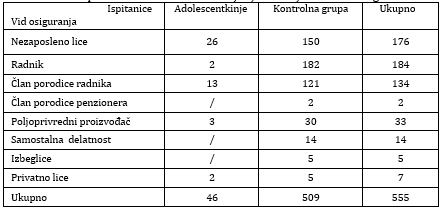
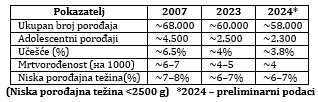
The majority of adolescent mothers are unemployed or dependents, while in the control group the number of employed women is significantly higher. Adolescent pregnancy and childbirth significantly reduce the possibility of continuing education and completing schooling, and consequently limit employment opportunities. All of this contributes to their lower socio-economic status and, therefore, lower standard of living. This, as well as unintended pregnancy, leads adolescent mothers more often than women in the control group to leave their newborns in the maternity ward. In 2025, out of 11 adolescent mothers, one was still a student, 6 were registered with the employment agency, and 4 were insured through family members. DISCUSSION The results indicate a significant trend of decreasing adolescent births in Zaječar, which may be attributed to better education and improved access to contraception, in line with global trends and World Health Organization data [4]. From 1999 to 2003 at the Gynecology and Obstetrics Department of the Health Center Zaječar, the cesarean section rate among adolescents was 13.54%, which is lower than our rate in 2007 (3). However, the higher cesarean section rate in 2025, similar to findings by Tomić et al. [8], reflects modern medical trends and defensive obstetrics in younger primiparous women. The higher birth weight of newborns in the more recent sample suggests better quality prenatal care and nutrition of pregnant women compared to the period two decades earlier [5,6]. Regional studies (Kosovska Mitrovica, Zemun) also show a decline in adolescent births, although with variability depending on socio-economic conditions. In Kosovska Mitrovica, over a 10-year period from 2000 to 2009, there were 6,335 deliveries and 396 (6.2%) adolescent mothers aged 12–19 years (7). In Zemun, from January 2016 to December 2022, there were 124 adolescent mothers, representing 1% of total deliveries (8). Socio-economic factors remain crucial—adolescent mothers are predominantly unemployed and economically dependent. Although an increasing trend in newborn birth weight was observed, the difference was not statistically significant due to the small sample size. According to data from the Institute of Public Health of Serbia “Dr Milan Jovanović Batut” [9], significant changes in reproductive trends in Serbia were observed between 2007 and 2023/2024. Specifically, the total number of births decreased by 14.70%, which is less pronounced than in Zaječar, where a 46.31% decrease was observed between 2007 and 2025. However, adolescent births in Serbia decreased from 6.5% to 3.8% (a reduction of about 51.1%), while the reduction in Zaječar was more pronounced at approximately 76.1%. The Batut data also show a decrease in stillbirths (overall), while risks in adolescent pregnancies remain higher and low birth weight is still more common among young mothers [9] (Table 9). Table 9. Analysis of adolescent pregnancies and perinatal outcomes in all of Serbia (2007–2024)[9]
(Low birth weight <2500 g) *2024 - preliminary data According to the UNICEF report and analysis from 2023 [10], global adolescent birth rates have decreased by more than 40% since 2000, with the rate among the 15–19 age group falling to 39 births per 1,000 girls. However, significant inequalities in these rates still exist, particularly in sub-Saharan Africa. Although progress is evident, early childbearing remains highly prevalent among vulnerable groups, often driven by child marriage and limited access to contraception. Key trends and data from the 2023 analysis indicate regional disparities: sub-Saharan Africa has the highest adolescent birth rate (93 births per 1,000 girls aged 15–19), while Western Europe and North America report the lowest rates. The decline by age group since 2000 shows that among girls aged 10–14 years, birth rates have decreased by approximately 70%, while among those aged 15–19 years the decrease is about 40%. Around 76% of first births among girls under 18 occur within marriage, which is often associated with a higher risk of violence and health complications. When socioeconomic factors are considered, adolescent pregnancy is more common among girls with lower educational attainment and poorer economic status. Due to the small sample of adolescents in the Gynecology and Obstetrics Department of the Health Center Zaječar, it is not possible to assess the risk of stillbirth; however, according to a report on health outcomes [11], newborns of adolescent mothers have a 50% higher risk of stillbirth, neonatal death in the first week of life, and severe morbidity compared to children of mothers in their twenties. Despite improvements and a reduction in adolescent births, if current trends continue, significant inequalities related to socioeconomic status in adolescent childbearing will persist, according to a 2023 study for Latin America and the Caribbean [10]. CONCLUSION In 2025, there was a significant reduction in the total number of deliveries at the Zaječar maternity ward compared to 2007, with a particularly pronounced decrease in adolescent births to only 11 cases (3.69%). Comparative analysis shows that the proportion of adolescent deliveries significantly decreased from 2007 (46 parturients – 8.28%) to 2025 (11 parturients – 3.69%) (χ² = 4.72; p = 0.029). No statistically significant difference was found in birth weight (t = 1.41; p = 0.16). The increased rate of cesarean sections indicates a change in obstetric practice. Although the frequency of cesarean delivery was higher in 2025, this difference was not statistically significant (χ² = 1.56; p = 0.21). In both 2007 and 2025, adolescent mothers were unemployed and economically dependent. One of the key tasks for obstetricians and gynecologists is to identify adolescents at risk and prevent behaviors leading to unintended pregnancy. Literature 1. Rot N, Radonjić S. Psihologija. Beograd: Zavod za udžbenike;
2007. p. 138-43. |
||||||||||||||||||||||||||||||||||||
|
|
||||||||||||||||||||||||||||||||||||
| [
Contents
] [ INDEX ]
|
||||||||||||||||||||||||||||||||||||
|
||||||||||||||||||||||||||||||||||||